Byzantine Bronze Thurible (Censer) Circa 8th - 10th Century A.D.
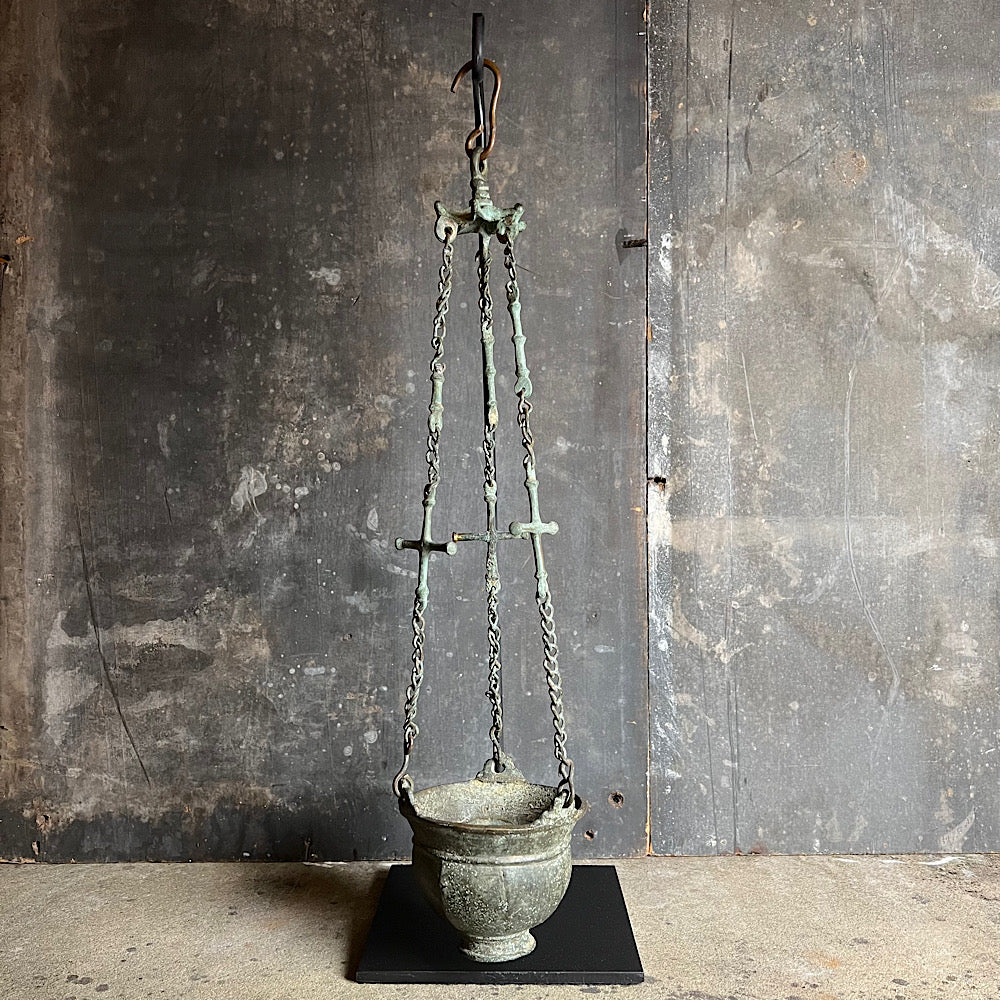
A rare and striking Byzantine bronze “thurible” circa 8th - 10th Century A.D.
Created between 700 - 900 A.D, this wonderful incense burner is one of the most beautiful items of Byzantine antiquity we have ever found.
The “censer” bowl is a simple cup-shaped bronze vessel with eight sides with the most minimal decoration. It’s very form being considered perfect.
The censer was made for religious use, three attachment loops on the rim of the bowl suspend it on hand-forged chains enabling it to be swung through the air to spread the incense smoke into to religious space. It was once believed that the incense smoke would protect against evil spirits, illness and purify the very air of the church.
Of note are the three crosses set within the centre of each chain: the cross being one of the symbols both sides agreed were acceptable within the church during and after the Iconoclast Controversy between 726 and 843 A.D. As strange as it must seem to us today, this difference of opinion on Church doctrine almost brought down the Byzantine Empire. The argument centred around the use of Iconography for worship within the Byzantine Empire.
Size with stand 51 cm h x 23 cm w x 15.5 cm d.
Provenance originally acquired from a London Ancient Art Gallery, direct from the America Art Market. The piece was in a private collection in New York City acquired from a New York City gallery previously and now with us.
Original: $8,515.65
-70%$8,515.65
$2,554.69More Images




Byzantine Bronze Thurible (Censer) Circa 8th - 10th Century A.D.
A rare and striking Byzantine bronze “thurible” circa 8th - 10th Century A.D.
Created between 700 - 900 A.D, this wonderful incense burner is one of the most beautiful items of Byzantine antiquity we have ever found.
The “censer” bowl is a simple cup-shaped bronze vessel with eight sides with the most minimal decoration. It’s very form being considered perfect.
The censer was made for religious use, three attachment loops on the rim of the bowl suspend it on hand-forged chains enabling it to be swung through the air to spread the incense smoke into to religious space. It was once believed that the incense smoke would protect against evil spirits, illness and purify the very air of the church.
Of note are the three crosses set within the centre of each chain: the cross being one of the symbols both sides agreed were acceptable within the church during and after the Iconoclast Controversy between 726 and 843 A.D. As strange as it must seem to us today, this difference of opinion on Church doctrine almost brought down the Byzantine Empire. The argument centred around the use of Iconography for worship within the Byzantine Empire.
Size with stand 51 cm h x 23 cm w x 15.5 cm d.
Provenance originally acquired from a London Ancient Art Gallery, direct from the America Art Market. The piece was in a private collection in New York City acquired from a New York City gallery previously and now with us.
Product Information
Product Information
Shipping & Returns
Shipping & Returns
Description
A rare and striking Byzantine bronze “thurible” circa 8th - 10th Century A.D.
Created between 700 - 900 A.D, this wonderful incense burner is one of the most beautiful items of Byzantine antiquity we have ever found.
The “censer” bowl is a simple cup-shaped bronze vessel with eight sides with the most minimal decoration. It’s very form being considered perfect.
The censer was made for religious use, three attachment loops on the rim of the bowl suspend it on hand-forged chains enabling it to be swung through the air to spread the incense smoke into to religious space. It was once believed that the incense smoke would protect against evil spirits, illness and purify the very air of the church.
Of note are the three crosses set within the centre of each chain: the cross being one of the symbols both sides agreed were acceptable within the church during and after the Iconoclast Controversy between 726 and 843 A.D. As strange as it must seem to us today, this difference of opinion on Church doctrine almost brought down the Byzantine Empire. The argument centred around the use of Iconography for worship within the Byzantine Empire.
Size with stand 51 cm h x 23 cm w x 15.5 cm d.
Provenance originally acquired from a London Ancient Art Gallery, direct from the America Art Market. The piece was in a private collection in New York City acquired from a New York City gallery previously and now with us.