Pair of Dutch Delft Apothecary Syrup Jars, “Oxym. Simpl.” & “S. Rhei”, Mid-18th century (c.1730–1760)
Pair of Dutch Delft Apothecary Syrup Jars, “Oxym. Simpl.” & “S. Rhei”, Mid-18th century (c.1730–1760)
A wonderful pair of Dutch Delft tin-glazed apothecary syrup jars Mid-18th century (c.1730–1760)
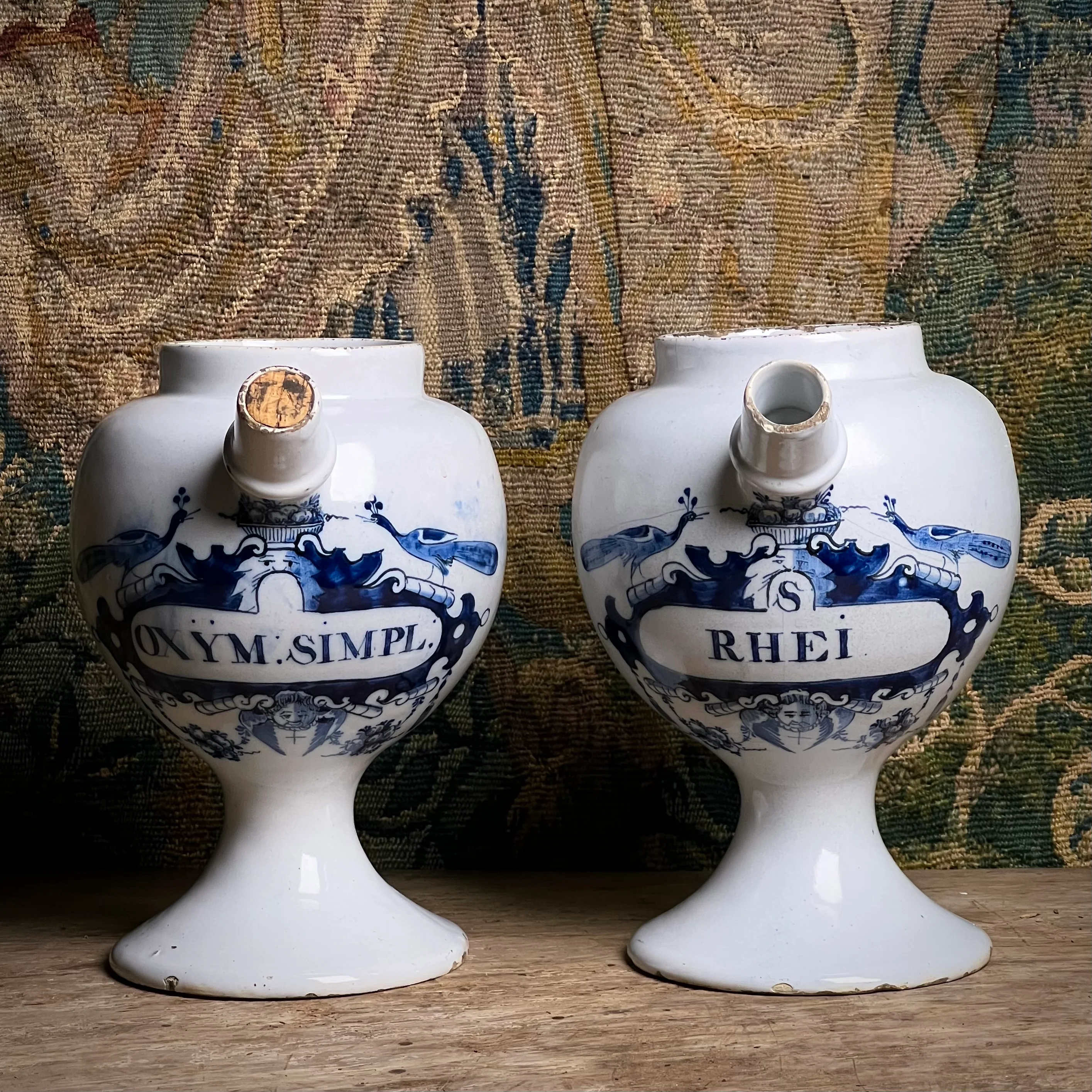
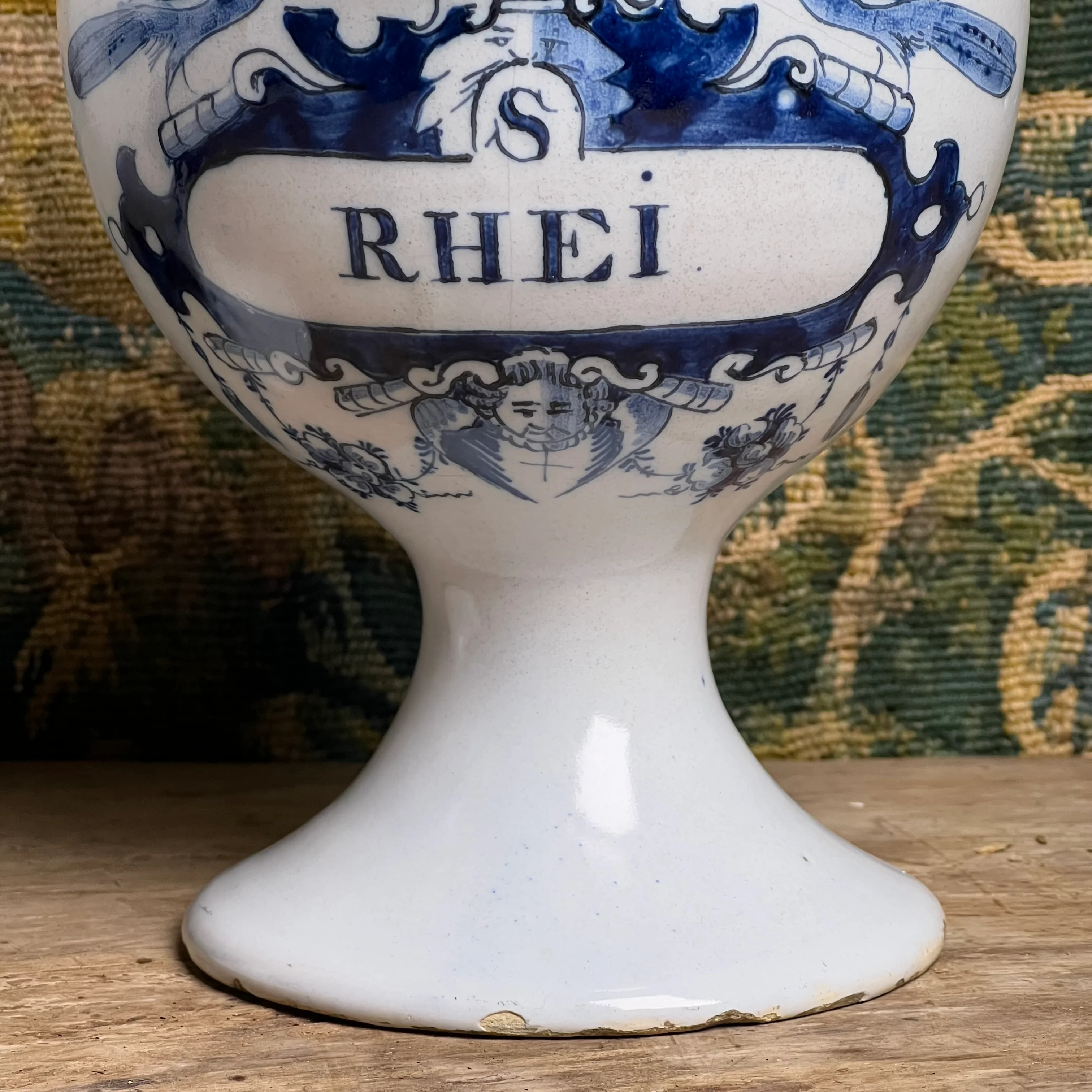
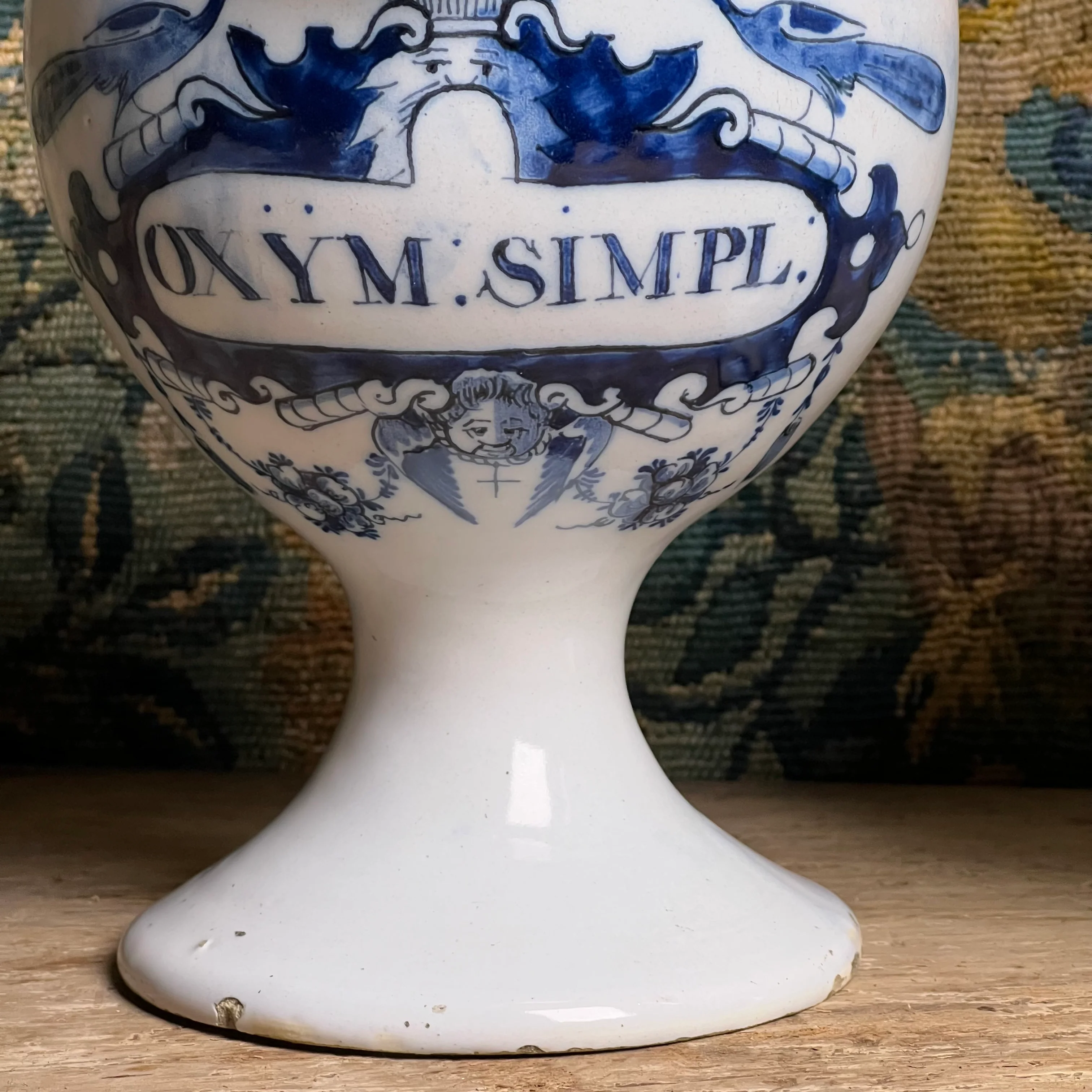
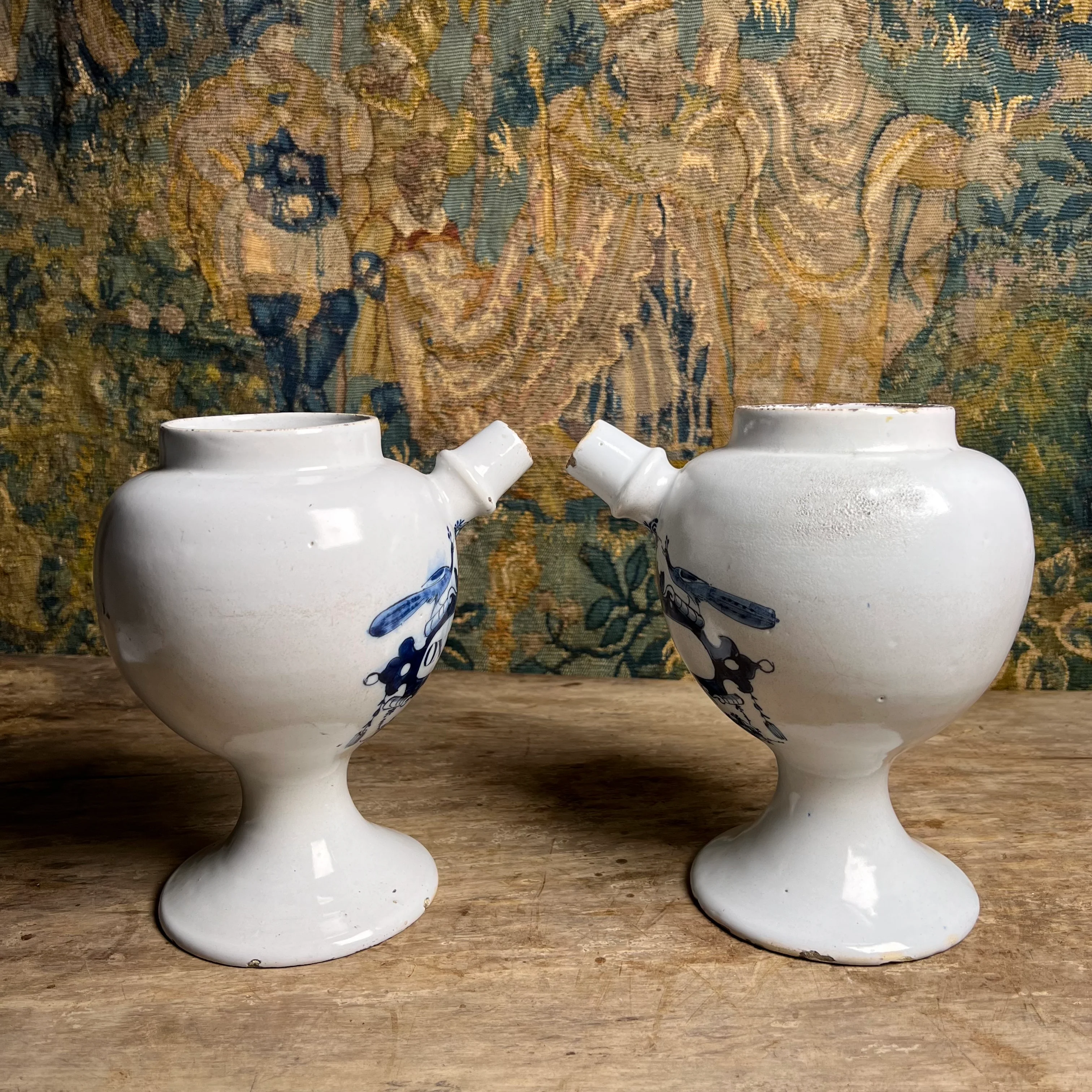
Each is raised on a tall pedestal foot and fitted with a side spout for pouring. One retains its cork stopper. Painted in rich underglaze cobalt, their bulbous bodies are wrapped with scrolling strapwork and bold cartouches with angelic faces and fruit filled baskets, inscribed “OXYM. SIMPL.” (Oxymel simplex — honey and vinegar) and “S. RHEI.” (Syrupus Rhei — rhubarb syrup), time-honoured preparations from the world of the early apothecary.
The scrolling cartouches flanked by peacocks represent one of the most important decorative motifs used on apothecary jars between 1650 and 1750. The cartouche form itself derives from sixteenth-century Renaissance design, adapted for pharmaceutical vessels.
The peacock was a deliberately chosen symbol. In Europe and Asia Minor it was long associated with mythical and medicinal qualities; in antiquity it was believed that the bird’s flesh could not decay, making it an especially apt motif for jars intended to preserve remedies.
Once housed in a pharmacy interior amongst rows of labelled jars — a cabinet of cures, simples and syrups. Made to be used, handled, refilled and poured.
Wear consummate with age.
Original: $2,395.03
-70%$2,395.03
$718.51More Images






Pair of Dutch Delft Apothecary Syrup Jars, “Oxym. Simpl.” & “S. Rhei”, Mid-18th century (c.1730–1760)
A wonderful pair of Dutch Delft tin-glazed apothecary syrup jars Mid-18th century (c.1730–1760)
Each is raised on a tall pedestal foot and fitted with a side spout for pouring. One retains its cork stopper. Painted in rich underglaze cobalt, their bulbous bodies are wrapped with scrolling strapwork and bold cartouches with angelic faces and fruit filled baskets, inscribed “OXYM. SIMPL.” (Oxymel simplex — honey and vinegar) and “S. RHEI.” (Syrupus Rhei — rhubarb syrup), time-honoured preparations from the world of the early apothecary.
The scrolling cartouches flanked by peacocks represent one of the most important decorative motifs used on apothecary jars between 1650 and 1750. The cartouche form itself derives from sixteenth-century Renaissance design, adapted for pharmaceutical vessels.
The peacock was a deliberately chosen symbol. In Europe and Asia Minor it was long associated with mythical and medicinal qualities; in antiquity it was believed that the bird’s flesh could not decay, making it an especially apt motif for jars intended to preserve remedies.
Once housed in a pharmacy interior amongst rows of labelled jars — a cabinet of cures, simples and syrups. Made to be used, handled, refilled and poured.
Wear consummate with age.
Product Information
Product Information
Shipping & Returns
Shipping & Returns
Description
A wonderful pair of Dutch Delft tin-glazed apothecary syrup jars Mid-18th century (c.1730–1760)
Each is raised on a tall pedestal foot and fitted with a side spout for pouring. One retains its cork stopper. Painted in rich underglaze cobalt, their bulbous bodies are wrapped with scrolling strapwork and bold cartouches with angelic faces and fruit filled baskets, inscribed “OXYM. SIMPL.” (Oxymel simplex — honey and vinegar) and “S. RHEI.” (Syrupus Rhei — rhubarb syrup), time-honoured preparations from the world of the early apothecary.
The scrolling cartouches flanked by peacocks represent one of the most important decorative motifs used on apothecary jars between 1650 and 1750. The cartouche form itself derives from sixteenth-century Renaissance design, adapted for pharmaceutical vessels.
The peacock was a deliberately chosen symbol. In Europe and Asia Minor it was long associated with mythical and medicinal qualities; in antiquity it was believed that the bird’s flesh could not decay, making it an especially apt motif for jars intended to preserve remedies.
Once housed in a pharmacy interior amongst rows of labelled jars — a cabinet of cures, simples and syrups. Made to be used, handled, refilled and poured.
Wear consummate with age.